Your Neighborhood Is Not an Intelligence File
We document police programs that bring monitoring, data collection, and unsolicited law-enforcement contact directly into residential communities — and we ask whether they are transparent, voluntary, and based on informed consent.
They call it community engagement. We document the surveillance.
Community engagement should be transparent, voluntary, and based on informed consent. When police departments announce plans to walk every residential street, knock on doors, record interactions, deploy surveillance technology, or collect neighborhood intelligence, residents deserve clear answers.
We track these programs, preserve the original public announcements, evaluate their privacy safeguards, and give communities the information they need to ask better questions.
We do not target individual officers. We examine policies, departmental practices, technologies, public records, and the decisions of government institutions.
Featured program
When “community engagement” comes armed to the front door
Beginning July 16, the Harrisonburg Police Department plans weekly “community walks” through residential neighborhoods — eventually every residential street in the city — knocking on doors to build a “community-driven strategic plan.” The stated goals are reasonable. The announcement leaves the limits unanswered.
Unanswered by the announcement
- Is participation voluntary?Residents deserve to know they may decline.
- Will body cameras record?Non-investigative conversations at private homes.
- What is written down, and retained?Notes about residents, homes, vehicles, cameras.
- Could it be used for enforcement later?Outreach data crossing into investigation.
The campaign
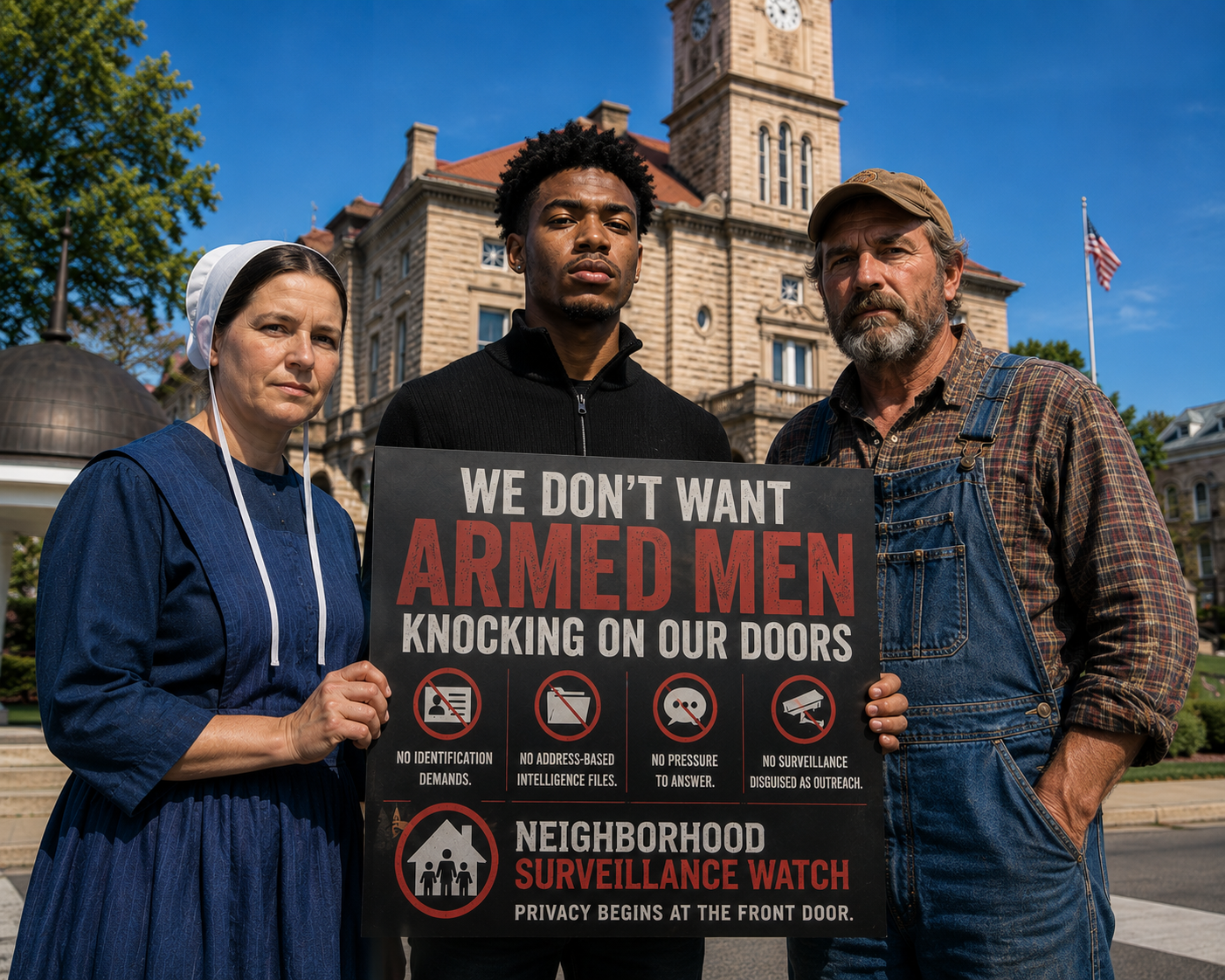
“We don’t want armed men knocking on our doors.”
Residents across backgrounds share one request: outreach that respects the boundary of a private home. These are the limits a trustworthy program should put in writing before the first knock.
- No identification demandsNo ID requested without a separate lawful reason.
- No address-based intelligence filesConversations not turned into records tied to your home.
- No pressure to answerDeclining is normal — never logged as suspicious.
- No surveillance disguised as outreachCommunity engagement is not an intelligence program.
What we track
Monitoring that comes to where people live
We focus on programs that bring law-enforcement data collection into residential space — and on whether residents are told what is happening.
Door-to-door canvassing
Police departments planning to walk or canvass residential streets, and door-knocking programs presented as “community engagement.”
Surveillance technology
License-plate readers, facial recognition, drones, and camera networks deployed in and around neighborhoods.
Consent & voluntariness
Whether residents are clearly told participation is voluntary — and whether declining is treated as normal, not suspicious.
What is recorded & retained
What information is written down, connected to an address, retained, or shared — and for how long.
Body-worn cameras
Whether footage is collected during non-investigative conversations at people’s homes.
Oversight & opt-outs
Whether departments provide privacy policies, opt-outs, and public oversight of the program.
How we rate
A transparency rating, not a verdict on officers
Each program is rated on how clearly its consent, data, and oversight practices are disclosed to the public.
Documented publicly, participation is clearly voluntary, and privacy safeguards are stated.
Some public information exists, but consent, retention, or oversight details are incomplete.
Little or no public information; consent and data practices are undisclosed.
Public safety should not require surrendering privacy at your own front door.
Know of a residential policing or surveillance program in your community? Help us document it.
Report a program